

MONEY MATTERS
What does it cost?
Let’s not pussyfoot around; what’s the bottom line? How much does it cost to cast aside your work-a-day life and traipse off around the world? If you ignore intangible costs (and you should because they’re more than offset by your awesome experience) the short answer is; who knows? Costs for independent around-the-world travel vary as much as independent around-the-world travelers themselves. The total cost for any long-term trip results from a bazillion unique decisions. What countries you visit, how you get from A to B, how long you stay, and the level of comfort you require, all impact your costs in a big way. Unfortunately, there’s no magic formula for us to share. What we can share is what a few things cost us, and also some insights we learned along the way.
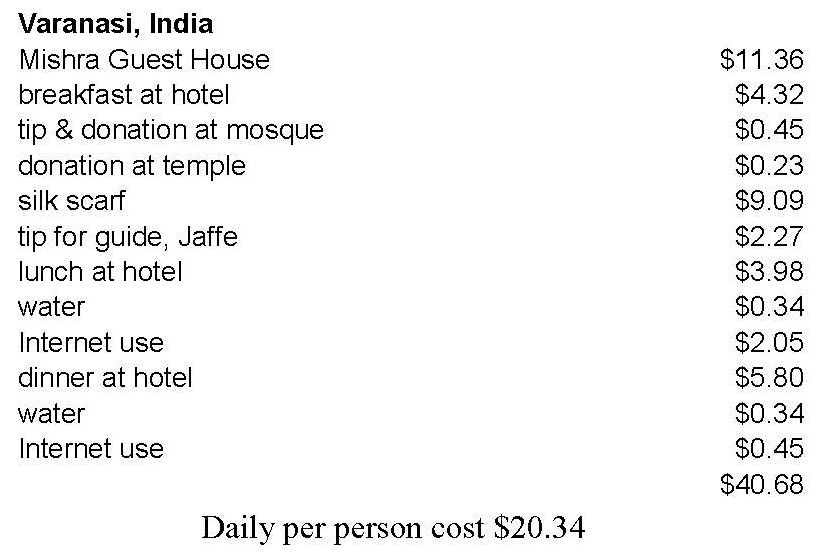
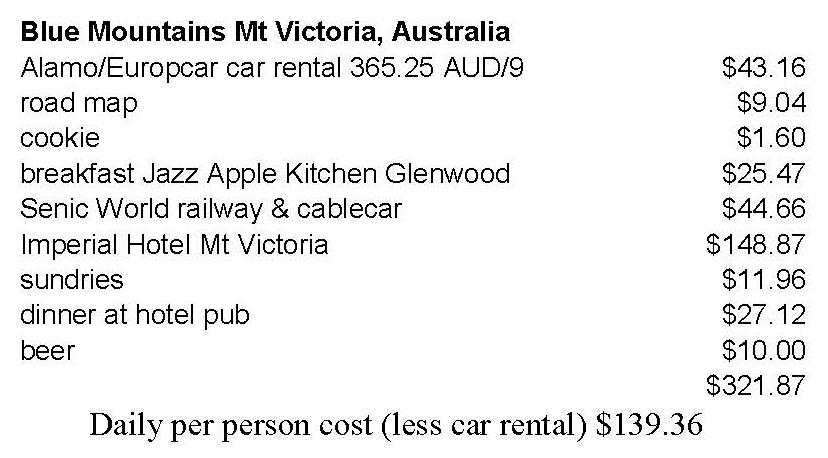
No matter how much you budget for your trip, it will cost more than you expect. This is rule number one, and anyone planning long-term travel should repeat it like a mantra. Some days will be absolute bargains; others will leave you grinding your teeth and scraping the bottom of your wallet. To get a feel for just how widely this pendulum can swing, look at our following one-day examples from Varanasi, India and Mount Victoria, Australia. Both expense lists are typical and, except for a car rental in Australia, they’re very similar. Both days, we stayed in a modest hotel, we paid for restaurant-prepared meals, we bought a few miscellaneous items, and we participated in an organized activity. If you ignore the car rental, our day in Australia still cost nearly seven times as much as our day in India. Guess which day made us gnash our pearly whites? Note: the prices below are from 2011; today expect 35% higher.
Faced with such a wide spread of potential expenses, how do you plan a big picture budget? According to some travel authorities, you don’t. Instead, of creating a macro budget for your entire itinerary, they suggest that you create a micro budget for each country that you want to visit. This is a great, probably bullet-proof, approach. Unfortunately it requires lots and lots of planning. If you’ve read our Boomers Away, you know that lots of planning runs afoul of our less-planning-is-more mode of travel.
To make things easier, we went with a big picture budget, which we approached from a different angle. Instead of trying to set a budget based on the ebb and flow of expected expenses, we set a daily budget based on how much we were willing to spend.
We researched travel expenditures until we felt reasonably certain that we understood what it costs to travel in developed areas such as the U.S. and Western Europe. Next, we extrapolated from those costs to determine a daily amount that we felt was reasonable to spend for First World travel. That became our baseline. Once on the road, we recorded all of our expenses (not as tedious as it sounds). We compared each day’s outlay against our “ideal” daily amount and we kept a running total of how much we were “under” or “over” budget. By watching what we spent in total and by comparing that amount to our “planned” spending, we always knew how much money we had left to work with.
This budget method served us quite well, but obviously it’s arbitrary and has plenty of caveats. First and foremost, it only works if your journey is open-ended and you know the total amount of money in your travel penny jar. Take the amount in your kitty and divide it by your ideal daily amount. The result is number of days your journey can last if you travel in developed countries and you stay on budget. If you overspend your budget, your journey will need to be shorter. If you spend less, you’ll get more days on the road or bigger splurges. The neat thing about this type of budget is that it can help you tweak your rambles. If you spend too much, you’ll know it, and you can move to cheaper environs. On the other hand, if you under spend, you’ll know when you can afford an extravagance.
Days spent on airplanes, in First World countries, and on safari are expensive. Days spent exploring local markets or wandering atmospheric backstreets can be cheap. As your expenditure pendulum swings from one extreme to the other, your over-under budget amount swings just as wildly. Nevertheless, if you watch the trends you’ll always know your bottom line and be able to squeeze the maximum experience from your journey.
So what was our bottom line? Before we stepped out our door, we decided on a budget of $100 each per day (today probably $135). Day in and day out: cruise ships, third world hostels, fourth world hotels, gourmet meals, street corner falafel carts, economy plane tickets, safaris, and overpriced taxis, our final per person cost hit $78 per day (today probably $105). Some people will look at this average and think it ridiculously high. Others will look at it and wonder how we managed to do so much on so little. The point is; that was our average, your mileage will vary. Buy souvenirs, which we didn’t, and your costs will go up. Bag the cruise ships and you might save $13 per person per day. Dumping safaris and river cruises might knock off another $4 per person per day. Requiring American style bathrooms might double your accommodation costs. Sleeping by the side of the road … well, you get the idea. Each purchasing decision you make goes straight to your bottom line. Our best advice; set a realistic total expenditure target that you find comfortable and then keep a close watch on your pennies. Do that and, with only a bit of luck, your dollars should watch out for themselves.
We’d like to say that’s the end of the story, but unfortunately it’s not. What you spend along the way is only part of a journey’s expense. Pre-trip expenses: buying luggage, getting medical checkups, etc. stack up rapidly and have to be taken into consideration. It’s also critical that you don’t overlook all the unavoidable expenses that you’re going to “leave behind.” Taxes, monthly health insurance premiums, rent, storage fees, and so on will all continue to come due whether you’re there or not. Don’t let “forgotten” bills cut your adventure short. Plan for them and keep them under control. There’s a lot to consider when budgeting for a long-term journey and at the start it can seem overwhelming, but if you stick with it, you’ll eventually come to understand your expenses and be able to manage them with panache!
Guidebooks take time to move from researchers’ notes to travelers’ hands, and during that time prices change. Changes are fueled by everything from global financial meltdowns to simple avarice and rarely work in the traveler’s favor. It’s also important to remember that most people who write guidebooks are professionals. That means they usually speak the local language, or they’re accompanied by someone who does. They know how to get the most for their: U.S. dollar, lempira, baht, or whatever and most cases will be able to stretch it much farther than you can. Another sad fact is that whenever a guidebook says anything nice about an enterprise, the “recommendation” frequently results in the proud owner doubling his or her prices. Our recommendation; use guidebooks, they’re essential, but treat the prices they contain as rough and probably low estimates.
Also, don’t be that person lugging massive definitive guides everywhere you go. Most guidebooks are available as eBooks and that is far and away the best way to carry them. For the weight of a single paper tome, an e-reader allows you to carry a whole library.
Some of you may read the proceeding paragraphs and be inclined to scoff, “How quaint.” In this Internet age, guidebooks might seem the epitome of “Old School.” The reality is that the Web is frequently unavailable (always at the least opportune time) and, while often “fresher,” the information posted on websites is just as prone to errors and inconsistencies.
When it comes to planning expenses, guidebooks and Internet sites are both valuable tools. Just remember, they’re not the absolute gospel truth.
To make things easier, we went with a big picture budget, which we approached from a different angle. Instead of trying to set a budget based on the ebb and flow of expected expenses, we set a daily budget based on how much we were willing to spend.
We researched travel expenditures until we felt reasonably certain that we understood what it costs to travel in developed areas such as the U.S. and Western Europe. Next, we extrapolated from those costs to determine a daily amount that we felt was reasonable to spend for First World travel. That became our baseline. Once on the road, we recorded all of our expenses (not as tedious as it sounds). We compared each day’s outlay against our “ideal” daily amount and we kept a running total of how much we were “under” or “over” budget. By watching what we spent in total and by comparing that amount to our “planned” spending, we always knew how much money we had left to work with.
This budget method served us quite well, but obviously it’s arbitrary and has plenty of caveats. First and foremost, it only works if your journey is open-ended and you know the total amount of money in your travel penny jar. Take the amount in your kitty and divide it by your ideal daily amount. The result is number of days your journey can last if you travel in developed countries and you stay on budget. If you overspend your budget, your journey will need to be shorter. If you spend less, you’ll get more days on the road or bigger splurges. The neat thing about this type of budget is that it can help you tweak your rambles. If you spend too much, you’ll know it, and you can move to cheaper environs. On the other hand, if you under spend, you’ll know when you can afford an extravagance.
Days spent on airplanes, in First World countries, and on safari are expensive. Days spent exploring local markets or wandering atmospheric backstreets can be cheap. As your expenditure pendulum swings from one extreme to the other, your over-under budget amount swings just as wildly. Nevertheless, if you watch the trends you’ll always know your bottom line and be able to squeeze the maximum experience from your journey.
So what was our bottom line? Before we stepped out our door, we decided on a budget of $100 each per day (today probably $135). Day in and day out: cruise ships, third world hostels, fourth world hotels, gourmet meals, street corner falafel carts, economy plane tickets, safaris, and overpriced taxis, our final per person cost hit $78 per day (today probably $105). Some people will look at this average and think it ridiculously high. Others will look at it and wonder how we managed to do so much on so little. The point is; that was our average, your mileage will vary. Buy souvenirs, which we didn’t, and your costs will go up. Bag the cruise ships and you might save $13 per person per day. Dumping safaris and river cruises might knock off another $4 per person per day. Requiring American style bathrooms might double your accommodation costs. Sleeping by the side of the road … well, you get the idea. Each purchasing decision you make goes straight to your bottom line. Our best advice; set a realistic total expenditure target that you find comfortable and then keep a close watch on your pennies. Do that and, with only a bit of luck, your dollars should watch out for themselves.
We’d like to say that’s the end of the story, but unfortunately it’s not. What you spend along the way is only part of a journey’s expense. Pre-trip expenses: buying luggage, getting medical checkups, etc. stack up rapidly and have to be taken into consideration. It’s also critical that you don’t overlook all the unavoidable expenses that you’re going to “leave behind.” Taxes, monthly health insurance premiums, rent, storage fees, and so on will all continue to come due whether you’re there or not. Don’t let “forgotten” bills cut your adventure short. Plan for them and keep them under control. There’s a lot to consider when budgeting for a long-term journey and at the start it can seem overwhelming, but if you stick with it, you’ll eventually come to understand your expenses and be able to manage them with panache!
About Guidebooks and costs
When planning a trip to unfamiliar areas, sooner or later you’ll turn to a guidebook. When you do, remember that the prices they list for accommodations, meals, and activities rarely reflect reality. Guidebook prices aren’t inaccurate because of careless research; they’re inaccurate because prices are always in flux.Guidebooks take time to move from researchers’ notes to travelers’ hands, and during that time prices change. Changes are fueled by everything from global financial meltdowns to simple avarice and rarely work in the traveler’s favor. It’s also important to remember that most people who write guidebooks are professionals. That means they usually speak the local language, or they’re accompanied by someone who does. They know how to get the most for their: U.S. dollar, lempira, baht, or whatever and most cases will be able to stretch it much farther than you can. Another sad fact is that whenever a guidebook says anything nice about an enterprise, the “recommendation” frequently results in the proud owner doubling his or her prices. Our recommendation; use guidebooks, they’re essential, but treat the prices they contain as rough and probably low estimates.
Also, don’t be that person lugging massive definitive guides everywhere you go. Most guidebooks are available as eBooks and that is far and away the best way to carry them. For the weight of a single paper tome, an e-reader allows you to carry a whole library.
Some of you may read the proceeding paragraphs and be inclined to scoff, “How quaint.” In this Internet age, guidebooks might seem the epitome of “Old School.” The reality is that the Web is frequently unavailable (always at the least opportune time) and, while often “fresher,” the information posted on websites is just as prone to errors and inconsistencies.
When it comes to planning expenses, guidebooks and Internet sites are both valuable tools. Just remember, they’re not the absolute gospel truth.
Credit Cards
Okay, let’s be blunt. Stick to Visa or MasterCard, use them carefully, and don’t depend on them being accepted. Before you ever whip out your card, you should think twice. Is this really a place I want to hand out my card number, signature, and security code? That said, we used our MasterCard all over the world without problems, but have had our identity stolen twice in less than a year since returning to the U.S. For our two cents, it’s always better to use cash and save the cards for have-to things like airfare and car rentals.ATMs
With the advent of the automatic teller machine, the question of how a traveler should carry their money took a quantum leap forward. ATM’s mean that you don’t need to walk out your door with your whole trip’s budget stuffed in your pocket. During our 16 month journey we used our debit card at ATMs 117 times, several in each country that we visited, and we withdrew a total of more than $25k spread across 15 different currencies. Most of the time, it was smooth sailing. Unfortunately, ATMs don’t solve the problem 100%. Yes, they’re ubiquitous and yes, they can be found world wide, but (read this twice) you still need to carry cash! Once you get out of the First World, there may be an ATM in your hotel lobby and another at the bank just around the corner, but that doesn’t mean that either one will work. Power outages and assorted technical issues frequently turn ATMs into the equivalent of high tech cinder blocks; and, just as frequently, they run out of money or impose daily withdrawal limits that are so low that, even after a maximum withdrawal, you’re still left in a bind.Fees
Another downside to credit and debit cards is fees! Banks, credit unions, and merchants all like to tack on a little something. Call them, convenience fees, foreign transaction charges, whatever; they may seem really low, just a percent of a percent, but over a long journey they can add up to real money. In our case, that came to $405!Cash
So that you don’t end up washing pots and pans or get hauled off to debtor’s prison, you should always keep enough cash squirreled away to cover your current bills, and to tide you over for the next few days. In addition to this basic buffer, which is probably best held in the local currency, you’ll also want to carry a goodly quantity of U.S. dollars. If you travel for long, you’ll soon discover that while some people might despise the United States, everyone loves the mighty greenback. Also, it is quite common for government officials, hotels, and other entities to demand U.S. dollars as the only acceptable form of payment.Sure there are other important currencies: the Euro, the Yen, etc. but believe us when we tell you that the world is full of places that will steadfastly refuse those monies, but will nevertheless happily accept U.S. dollars
It’s easier to hand out U.S. dollars than it is to pick them up in foreign countries, so we recommend that you carry your stash from home and only use them when there’s no other choice.
Bring a range of denominations; some big bills that you keep hidden away for emergencies, and a stack of small ones for simple transactions. Carry a huge wad of 1$ bills. Depending on the planned length of your trip you may want 100 or more. So many small bills is a bit of a hassle, but they’re often indispensible. When you step off a ferry boat in the middle of the night and all the banks and exchange counters are closed, if the taxi to your hotel costs the equivalent of $2 U.S. but all you have is a U.S. $20 bill, guess how much you’re going to pay? Pretty much everyone, everywhere, knows the value of a greenback and will accept $1 bills for goods and services. Split your big stack of ones into separate packets and spread them around in your luggage and on your person. Take our word for it; they may seem like too many when you step out your door, but by the end of a long trip you’ll be wishing for more.
Whether you’re collecting pre-trip dollars from your local bank or receiving currency in a foreign country, look over what you are being given. In much of the world, currency changes frequently and counterfeiting is a big deal. As a result pretty much everyone is reluctant to accept old, tattered, tagged, or torn bills. On the other hand, they’re just as eager to get rid of them by pawning them off on you.
When you put together your stash of greenbacks, tell your bank that you want only recent, fresh, clean bills. Don’t take bills over five years old and (god forbid) absolutely none that predate our last (big head) currency update; no tears, and no “Happy Birthday” in felt pen; repeat, recent, fresh, clean bills.
The same holds true when a merchant (or bureaucrat) hands you a bill in a foreign country. If it doesn’t look like any of the other bills you’ve seen of the same denomination, or it’s scribbled on, or it looks like someone’s been carrying it around in their shoe for a couple of years, politely refuse to accept it and ask for another.
Traveler’s Checks
Okay, we hear you snickering. In this modern technological world, you’ve doubtless heard the oft repeated dictum that, “the traveler’s check is dead.” Not true! Traveler’s checks are still an important leg to your money tripod: bankcards, cash, T-checks. Well known traveler’s checks like American Express, are safe to carry, and are still widely accepted. Sure you might pay a cashing fee or face a long wait at a bank, but just as frequently, your hotel will take them without a second look. And, if you have the misfortune to have your T-checks stolen, well… in theory, they’re easily replaced. Take at a reserve in traveler’s checks that is at least as large as your reserve in cash. Be sure to keep your receipts and a list of numbers separate from the checks themselves.