

Travel with a CPAP
A CPAP will change the way you approach things, but it’s not a boat anchor. With modest preparation, there’s no reason that sleep apnea should chain you at home. My CPAP and I were best buddies on our trip, and by repeated trial and error I discovered what works and what doesn’t. To save you the same legwork, here come my top 10 tips for the “traveling hose-head.”
1) You’ll need to lug your CPAP everywhere you go. When you’re out sightseeing, you’ll leave it in your hotel, hostel, or tent, but, anytime you’re on the move, it’ll be your constant companion. You don’t want it to be an obnoxious overweight companion that hogs your seat. CPAPs aren’t made from cinderblocks, but that doesn’t mean some of them aren’t bulky and heavy. A long day of trains, planes, or buses can leave you feeling your CPAP’s every ounce and cursing its every awkward bulge. Try to get the smallest lightest model that you can afford.
2) Whatever CPAP you choose, it MUST be able to run off a battery! In the United States, we take consistent uninterrupted electricity for granted. In other parts of the world, it’s the exception rather than the rule. If you spend any time in developing countries, it won’t be long before the power fails. When the lights turn brown and flicker, or go out altogether (and be assured they will) you want your CPAP to keep on going! Buy the best quality lithium ion battery that you can afford. A good battery, specifically designed for CPAP use, will weigh 1.5lbs to 3.25lbs and be about the size of a large paperback book. Depending on your device’s pressure setting it may power your unit for up to 3 nights without a recharge. Two or three nights won’t get you to the top of Mount Kilimanjaro and back, but it will usually meet your needs.
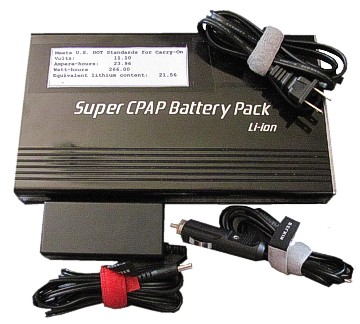
In some areas power is so inconsistent that you’ll want to use a battery every night. Stick with a 12v CPAP. That way, if your battery goes dead before the power comes back, a car battery and the right set of cables (which of course you’re carrying) can keep you sleeping soundly.
When choosing a battery, also check U.S. Department of Transportation standards for current restrictions on “equivalent lithium content” for batteries carried onto airplanes. Currently (2023) lithium ion rechargeable batteries are limited to a rating of 100 watt hours (Wh) per battery. You want a powerful battery, but you don’t want one that isn’t allowed to fly.
3) Batteries eventually need to recharge, and although they’re awesome, sometimes it’s just more convenient to plug in. When that time comes, you want to be prepared. Worldwide, “standard” voltages range from 110 to 240 volts and “standard” frequency is either 50 or 60 Hz. In the U.S. we use 110-120 volts and 60 Hz AC, but your CPAP and battery charger MUST both handle any range you encounter. Check your power specifications carefully and be sure they read 110-240v and 50-60 Hz. If they don’t, you should either choose different equipment, or purchase (and lug along) a universal power converter.
When choosing a battery, also check U.S. Department of Transportation standards for current restrictions on “equivalent lithium content” for batteries carried onto airplanes. Currently (2023) lithium ion rechargeable batteries are limited to a rating of 100 watt hours (Wh) per battery. You want a powerful battery, but you don’t want one that isn’t allowed to fly.
3) Batteries eventually need to recharge, and although they’re awesome, sometimes it’s just more convenient to plug in. When that time comes, you want to be prepared. Worldwide, “standard” voltages range from 110 to 240 volts and “standard” frequency is either 50 or 60 Hz. In the U.S. we use 110-120 volts and 60 Hz AC, but your CPAP and battery charger MUST both handle any range you encounter. Check your power specifications carefully and be sure they read 110-240v and 50-60 Hz. If they don’t, you should either choose different equipment, or purchase (and lug along) a universal power converter.
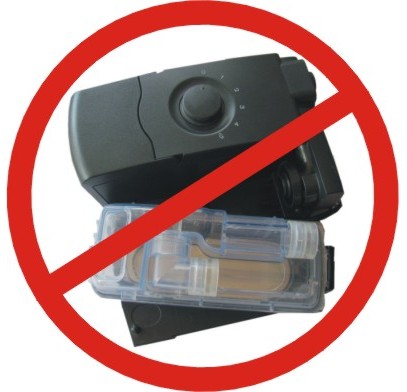
4) Ditch the humidifier! Most people, who are prescribed a CPAP are pointed to one that includes a humidifier. Humidifiers moisten the air that CPAPs pump into a user’s mask and may (or may not) make for a more comfortable sleep experience. Unfortunately for long-term travelers, humidifiers have big downsides. First off, to warm the water in their reservoirs they draw lots of power. That means you can’t run a humidifier off your battery. Strike one! Most humidifiers want to be filled with distilled water. Take our word for it, you won’t find any. Strike two! Humidifiers wet the inside of the CPAP supply tube and mask which promotes the growth of mold and other cleanliness issues. To keep the unit sanitary requires daily cleaning; not so easy, when your tap water isn’t potable. Strike three! The bottom line is, humidifiers add extra bulk and weight, and it’s likely you don’t really need one. Learn to sleep without it (it’s easier than you think). If you’re shopping for a CPAP and you want to keep your options open, buy a unit with an external add-on humidifier. That way, you can leave it at home. If a CPAP’s humidifier is built in, don’t buy the CPAP.
5) Take along plenty of plug adapters! There are a dozen common types of wall outlets and corresponding plugs in use around the world. As you move from country to country, the type is going to change. You don’t need a dozen adapters, but if you plan on serious rambling, pick up several of the most common. If your adapters are two-prong (most are), and your CPAP power cord or battery charger isn’t, be sure to throw in a two-prong to three-prong grounding adapter. You won’t actually ground anything, but at least stuff will plug together cleanly. When the day comes (and it will) that your battery is in the middle of charging and you really, absolutely, unequivocally need to plug in a computer, an iPhone, or a fill-in-the-blank, don’t freak. People everywhere buy foreign electronics and it’s usually fairly easy to pick up an extra local adapter from a nearby market, hole-in-the-wall electrical supply, or a guy selling cell phone chargers on the sidewalk. That said; it’s less hassle if you just carry a few from home.
5) Take along plenty of plug adapters! There are a dozen common types of wall outlets and corresponding plugs in use around the world. As you move from country to country, the type is going to change. You don’t need a dozen adapters, but if you plan on serious rambling, pick up several of the most common. If your adapters are two-prong (most are), and your CPAP power cord or battery charger isn’t, be sure to throw in a two-prong to three-prong grounding adapter. You won’t actually ground anything, but at least stuff will plug together cleanly. When the day comes (and it will) that your battery is in the middle of charging and you really, absolutely, unequivocally need to plug in a computer, an iPhone, or a fill-in-the-blank, don’t freak. People everywhere buy foreign electronics and it’s usually fairly easy to pick up an extra local adapter from a nearby market, hole-in-the-wall electrical supply, or a guy selling cell phone chargers on the sidewalk. That said; it’s less hassle if you just carry a few from home.
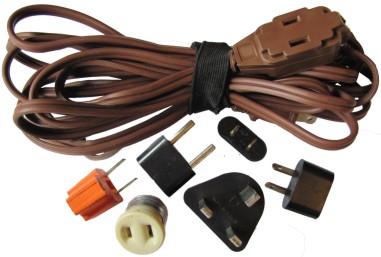
6) If you stay in budget accommodations,
you’ll quickly discover that many countries consider wall outlets an optional
luxury. It’s quite common for a modest hotel room to have a single outlet in
the bathroom, or none at all. Along with your adapters, you need to carry one
of those do-hickeys that screws into a light socket and changes it to a
two-prong outlet. You also need to carry a standard extension cord that’s at
least 15 feet long. Equipped with these two items you have the ability to plug
into that distant outlet over the sink, or tap into power by unscrewing the
bare bulb dangling over your bed. Travel for very long, and at some point
you’ll need them both.
About the extension cord; in the U.S. UL approved extension cords come polarized with one prong wider than the other. Elsewhere this isn’t the case, and in many areas you’ll find that your U.S. cord won’t fit into either an outlet or your adapter. The way around this dilemma is to whip out: your Swiss Army knife, your Leatherman tool, or a humble nail file and file down the wide prong. Such an action is of course strictly verboten, but it will instantly solve your problem. Be prepared; buy an extension cord with its wide prong widened by flanges; much easier to file down than one that’s wide along its entire length.
About the extension cord; in the U.S. UL approved extension cords come polarized with one prong wider than the other. Elsewhere this isn’t the case, and in many areas you’ll find that your U.S. cord won’t fit into either an outlet or your adapter. The way around this dilemma is to whip out: your Swiss Army knife, your Leatherman tool, or a humble nail file and file down the wide prong. Such an action is of course strictly verboten, but it will instantly solve your problem. Be prepared; buy an extension cord with its wide prong widened by flanges; much easier to file down than one that’s wide along its entire length.
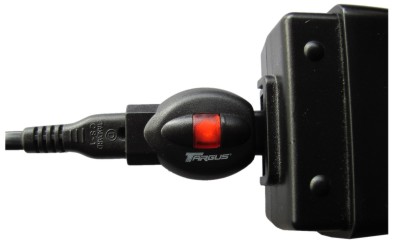
7) Bring a surge protector and use it
religiously. This tends to be a trade-off, as the better a surge protector
works the heavier and bulkier it tends to be. Most also require a grounded
three-prong outlet which can make them difficult to use correctly. A great
alternative is tiny in-line protectors that fit between power cords and the
devices they plug into. They might not work quite as well as full sized units,
but they weigh next to nothing, take up almost no space, and offer reasonable
peace of mind.
8) When it comes to your CPAP cleanliness is next to godliness. The bad news is that keeping spic and span on the road is a challenge. The good news is that, if you’ve ditched your humidifier, you don’t need to clean as frequently. When the water from the tap is suspect, scrub with bottled drinking water; it’s available everywhere and shouldn’t introduce unwanted bugs. It’s also a good idea to carry a small bottle of dish soap to use for washing hoses and masks. If you want to disinfect, try white household vinegar it’s cheap, widely available, works passably well, and shouldn’t harm your equipment. Last but not least, if your unit uses disposable filters, be sure that you pack enough to last your entire trip. You won’t find replacements in the public market in Pushkar!
8) When it comes to your CPAP cleanliness is next to godliness. The bad news is that keeping spic and span on the road is a challenge. The good news is that, if you’ve ditched your humidifier, you don’t need to clean as frequently. When the water from the tap is suspect, scrub with bottled drinking water; it’s available everywhere and shouldn’t introduce unwanted bugs. It’s also a good idea to carry a small bottle of dish soap to use for washing hoses and masks. If you want to disinfect, try white household vinegar it’s cheap, widely available, works passably well, and shouldn’t harm your equipment. Last but not least, if your unit uses disposable filters, be sure that you pack enough to last your entire trip. You won’t find replacements in the public market in Pushkar!
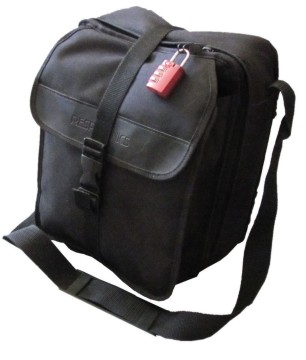
9) A good carrying case is essential.
You’ll be lugging your CPAP a lot so you need a case that’s rugged, protective,
and secure. If that doesn’t sound like the one that came with your CPAP, you
need to go shopping. Your hands will often be full, so forget about handles and
get a case with a good (wide) shoulder strap. It’s also super convenient if
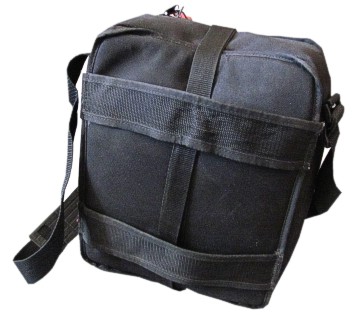
your CPAP case can be slipped over your suitcase or rolling backpack handle.
That way, you can give your back a rest and wheel it through airports and along
cracked sidewalks. If this isn’t a feature your case offers, have a shoe repair
place sew on a pair of 3 inch nylon straps (see photo below) and you’re all set.
Two accessories to consider are a 1-inch-wide nylon compression strap and a
small combination suitcase lock. The strap will keep the contents of your case
from shifting and it’s also handy when you don’t want your CPAP skidding across
the deck of a rocking ferryboat. The lock won’t keep out thieves, but it will
keep your case closed unless you really want it open.
10) Most Airport security personnel and customs agents are familiar with CPAPs, but that doesn’t mean they all are, or that procedures are consistent. Sometimes, you’ll breeze through and no one will give your CPAP a second glance. Other times you’ll be asked to open your case, pull out all the contents, and explain everything. To help grease the skids, print a set of manuals and keep them in the bottom of your case. If the need arises, you can hold them up for show and tell. It’s also a good idea to affix a label to your battery that helpfully lists its equivalent lithium content. Remember; never put your CPAP or battery, into your checked baggage. They’re exempt from pieces-of-luggage limits and should ALWAYS be carried.
On a final note; while it’s good practice to keep your battery and adaptors in the case with your CPAP, you should tuck the extension cord into one of your checked bags. Early on, ours was confiscated. Airport security deemed it an unacceptable risk and refused to allow it into the cabin. We suppose they had visions of me whipping out my extension cord, charging down the aisle, strangling the pilot, and hijacking the flight for points unknown. Anyway, heads-up; long extension cords can rank right up there with the tiny files you find on nail clippers.
On a final note; while it’s good practice to keep your battery and adaptors in the case with your CPAP, you should tuck the extension cord into one of your checked bags. Early on, ours was confiscated. Airport security deemed it an unacceptable risk and refused to allow it into the cabin. We suppose they had visions of me whipping out my extension cord, charging down the aisle, strangling the pilot, and hijacking the flight for points unknown. Anyway, heads-up; long extension cords can rank right up there with the tiny files you find on nail clippers.
Oh yeah, I almost forgot! None of my tips will do you any good if you get off a bus and leave your forgotten CPAP wedged under your seat. ALWAYS count your pieces of luggage! Spoken from experience.